The T in ChatGPT: What AI Search Optimization Actually Requires in 2026
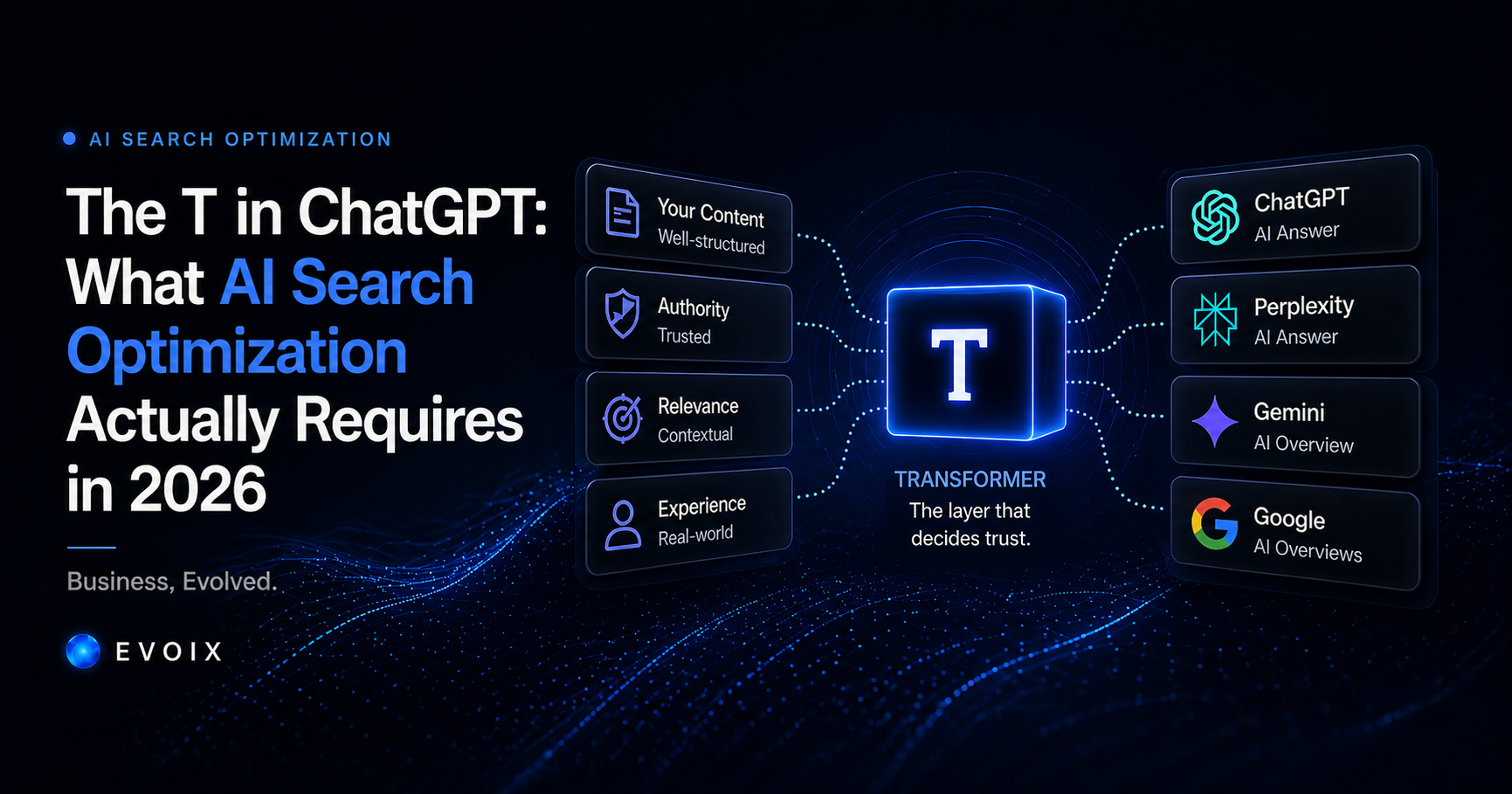
AI search optimization is the practice of structuring your business, content, and digital footprint so large language models like ChatGPT, Perplexity, Gemini, and Google AI Overviews recognize and recommend you. It is broader than AEO. It starts at the transformer layer, where every modern AI search tool decides which entities it trusts.
The T in ChatGPT stands for Transformer.
Google quietly introduced transformer architecture into its search algorithm in 2019, six years before the term "Answer Engine Optimization" showed up in anybody's pitch deck. When ChatGPT went public in 2022, it used the same underlying technology. Perplexity, Gemini, Claude, Copilot, and every Google AI Overview you see today all run on the same foundational machinery.
That single fact changes everything about how small businesses should think about getting found online. And most agencies, including the ones selling you AEO services right now, are missing it.
AEO is already becoming a commodity term
Answer Engine Optimization was a useful phrase for about eighteen months. It gave the industry a label for the shift away from "ten blue links" toward AI-generated answers. Business owners could finally understand what was happening to their search traffic. Consultants could finally describe what they were selling. If you want the foundation, we cover AEO fundamentals in a separate post.
Now every SEO agency in the country has an "AEO package" bolted onto their existing services. Which means AEO is about to become what SEO became in 2015: a crowded, commoditized service where everyone promises the same thing and nobody owns anything.
The businesses that win the next decade of AI search are not going to win because they hired someone to "do their AEO." They are going to win because they understood the actual mechanic underneath and optimized for it at a deeper level than anyone selling them surface tactics.
What the transformer actually cares about
Here is the thing almost nobody is saying out loud. Google's algorithm and every AI search tool you have ever heard of run on the same transformer architecture. They do not look at your business the way a human does. They look at entities.
An entity is the machine's way of understanding what something is. Your business is an entity. Your Google Business Profile is an entity. Your website is an entity. Your services, your location, your staff, your reviews, the articles written about you, the YouTube videos that mention you: all entities.
The transformer's job is to decide whether all of those entities tell a consistent story.
When they do, the AI gains confidence that your business is real, that it does what it claims to do, and that it belongs in the answer when someone asks a question in your category. When they do not, the AI quietly skips you and recommends someone else.
This is not classic SEO. This is not AEO in the commodity sense. It is something more fundamental. We call it Entity Alignment for AI Search, and it is the foundation of real AI search optimization.
AI search optimization vs AEO: the real distinction
AI search optimization and AEO overlap, but they are not the same thing. Getting this distinction right matters if you are deciding how to spend a limited budget.
AEO is a subset. It is specifically the work of getting your content cited inside direct-answer surfaces like Google AI Overviews, voice assistants, and AI chat responses. Good AEO work means schema markup, FAQ formatting, question-based headings, and a 40 to 60 word direct answer near the top of each page. Those tactics are real and they help. They are also widely documented and increasingly commoditized.
AI search optimization is broader. It covers everything AEO does, plus the entity-level work that determines whether any AI model considers your business trustworthy in the first place. It includes:
- Consistency across every digital surface that mentions you
- Generative engine optimization (GEO) for ChatGPT, Perplexity, Gemini, and Claude
- Brand mention strategy across Reddit, industry publications, and niche forums
- Schema markup tuned for entity recognition, not just content type
- Review density and specificity across review platforms
- AI crawler accessibility (robots.txt, llms.txt, structured sitemaps)
- Content depth that demonstrates topical authority to transformer-based models
AEO is a tactic. AI search optimization is the discipline. If you want the lateral comparison to classic SEO, we break down how AEO and SEO differ in detail. The short version: SEO drives traditional rankings, AEO captures the direct-answer surfaces, and AI search optimization is the broader strategy that wins across all of them.
How AI search optimization actually works
Most AI search optimization content stops at tactics. Here is the operating model underneath, because the tactics only work when the model underneath is sound.
1. The transformer reads entities, not pages. Every modern AI system, from Google AI Overviews to ChatGPT to Perplexity, parses the web into entity graphs. Your business is a node. Your services, location, staff, and mentions are nodes. The edges between them are the relationships the model uses to decide whether your business is real, trusted, and relevant to a given query. Optimizing for this means working at the entity level, not just the page level.
2. Structured data is the clearest signal you can send. Schema markup (JSON-LD) is a direct line to the transformer. It tells the model exactly what your business is, what services you offer, where you operate, and how your content is organized. Organization, LocalBusiness, Service, FAQPage, and Article schemas are the basics. Most small business sites have none of them. Adding them correctly is the single highest-impact technical change available.
3. Machine-readable content gets lifted more often. Short, self-contained paragraphs of 50 to 100 words get quoted by AI models. Long paragraphs buried inside marketing copy get ignored. Question-based H2 headings followed immediately by a direct answer is the pattern that wins. The AI Overview itself prescribes this structure in how it assembles answers.
4. Trust aggregates across the web. AI models reference content they have seen quoted or mentioned by other trusted sources. A mention on a niche Reddit thread, a guest post on an industry blog, a review on a third-party platform, and a quote in a podcast transcript all feed the model's confidence in your entity. Brand mentions without backlinks still count because the model reads the surrounding text, not just the hyperlink.
5. Consistency outweighs volume. Ten inconsistent listings across directories hurt more than one clean listing. Your business name, address, phone, services, and hours need to match everywhere a machine can read them. Every mismatch is a data point the transformer treats as evidence that you are not a canonical source.
Get these five right and the tactical layer (FAQ pages, direct-answer paragraphs, schema) does what it is supposed to do. Skip them and no amount of on-page AEO work will move the needle.
What we see in real small business audits
Every week we run AEO audits on small business websites. What we see in real small business audits follows a consistent pattern, and it is not what most agencies lead with.
The biggest single gap is structured data. Most small business sites have no schema markup at all. No Organization schema. No LocalBusiness schema. No Service schema. The site tells human visitors what the business does, but it tells AI models nothing. That alone explains why a lot of businesses are invisible inside AI answers.
The second gap is profile-to-website mismatch. A Google Business Profile lists six services. The website has one page about the main service and nothing about the other five. From the transformer's point of view, those five services do not exist on the canonical source (the website), so the confidence score drops.
The third gap is inconsistent name, address, and phone data across directories. A business appears on Yelp, Google, Bing, Apple Maps, and a few industry-specific directories. Each listing has a slightly different phone number format or abbreviated address. To a machine, that is evidence of multiple businesses or an unreliable entity. Either way, confidence drops.
None of these gaps require expensive content production to fix. They require attention to the machine-readable layer of your business, which is the layer most small business owners have never been told exists.
Why this changes your AI visibility strategy
AI visibility is growing fast as a business concern. Searches for the term have climbed by more than thirty times in the past year alone, because small business owners are starting to notice their competitors showing up in ChatGPT answers while they do not.
If you are planning an AI visibility strategy for 2026, three things should frame the work.
First, start with the entity, not the content. A beautiful blog post published on a site with no schema markup, inconsistent profile data, and zero third-party mentions will not move AI visibility. A moderately written service page on a site with clean structured data, aligned profile data, and a handful of trusted brand mentions will. The order of operations matters.
Second, expect zero-click growth. A rising share of AI visibility does not translate into classic website traffic. The user reads the summary, decides you are the right business, and contacts you directly. Your analytics might not catch the referral at all. This is why measuring AI visibility requires new metrics: citation rate, brand mention volume, and branded search lift, not just sessions and organic clicks.
Third, treat every digital surface as training data. Your Reddit profile, your Yelp listing, your LinkedIn posts, your YouTube channel description, and your Google Business Profile are all training inputs for the next generation of AI models. Sloppy, abandoned, or missing profiles are a long-term liability. Clean, active profiles compound into AI visibility for years.
Is SEO dead or evolving?
SEO is not dead. It is the foundation of AI search optimization.
Transformers still favor domains Google already trusts. Rankings still correlate with citation likelihood inside ChatGPT and Perplexity. Technical SEO still matters because AI crawlers need to access your content. What has changed is that ranking by itself is no longer the finish line. It is the entry ticket.
The businesses winning in 2026 still do SEO well. They just do three other things on top of it: schema-first AEO, entity alignment across their full digital footprint, and intentional brand mention strategy for the generative ecosystem.
Frequently asked questions
What is AI search optimization?
AI search optimization is the practice of structuring your business, content, and digital presence so large language models like ChatGPT, Perplexity, Gemini, and Google AI Overviews recognize and recommend you. It includes traditional SEO, answer engine optimization (AEO), generative engine optimization (GEO), and the entity-level work that determines whether AI models trust your business as a canonical source.
Is AI search optimization the same as AEO?
No. AEO is a subset of AI search optimization. AEO focuses on direct-answer surfaces like Google AI Overviews and voice assistants. AI search optimization is broader, covering generative AI platforms, entity consistency across directories, schema markup for entity recognition, and the brand mention strategy that feeds trust signals to transformer-based models.
Can you do SEO with AI?
Yes, and you should, but not in the way most agencies mean. Using AI to generate generic content at scale is the fastest way to hurt rankings. Using AI to analyze your entity consistency, audit your schema markup, identify citation gaps, and write precise question-answer content with human oversight is where the real gains come from. AI is a tool for the work, not a substitute for the strategy.
How do you optimize for ChatGPT, Perplexity, and Gemini?
The work is the same across all three because they run on similar transformer architecture. Clean schema markup, consistent entity data across every directory and social profile, brand mentions on trusted third-party sources (Reddit, industry publications, niche forums), review density on platforms the models index, and content structured with question-based headings plus short direct answers. Optimize the entity layer once and you improve visibility across every generative AI platform at the same time.
What to do next
Start with a clear picture of where your entity is aligned and where it is fractured. Specifically:
-
Pull up your Google Business Profile and your website side by side. List every service and category on the profile. Then check whether each one has a dedicated page on the website. Missing pages are entity gaps. Fix those first.
-
Check your schema. Visit your homepage, view source, and search for "application/ld+json". If you find nothing, you have no structured data. That is the single highest-impact fix available.
-
Audit your name, address, and phone format across five places: website footer, Google Business Profile, LinkedIn, Yelp, and one industry-specific directory. Every variation is a trust erosion. Canonicalize them.
-
Find three places online where your business could plausibly be mentioned but is not. Reddit communities in your niche. Local forums. Industry Discord servers. Podcast interview opportunities. Each new mention is a new training signal for the transformers deciding who to cite.
-
Stop writing generic blog posts. They do not move entity alignment. Write pages that answer specific questions tied to specific services tied to specific locations. Or skip written content entirely and invest in a single AI-ready tool your prospects actually use.
If you want a precise, measured picture of where your own business sits right now, take our free AI Readiness Audit. It measures entity alignment directly, not just surface AEO signals. The output is a prioritized list of fixes specific to your site, your market, and how the transformer architecture currently sees you.
Need deeper help? Our Answer Engine Optimization service includes the full entity alignment work, schema implementation, citation strategy, and ongoing monitoring as the AI landscape shifts. For the hard numbers on how seldom AI engines currently cite small businesses, see our 4-engine citation audit.
Source and further reading
The T-in-ChatGPT hook and the core observation that transformers treat every business, profile, service, and review as an entity was sharpened for me by Caleb Ulku, a local SEO operator who has been teaching "entity matching" and "entity consistency" for years. His focus is local service businesses and the gap between Google Business Profile data and website structure. This post extends that insight into a broader framework for all small businesses competing in AI search: schema markup, brand mention strategy across Reddit and niche forums, review density, AI crawler accessibility, and NAP consistency across directories. If local service SEO is your primary concern, his video Build An SEO-Perfect Website With AI is worth your time.
The T in ChatGPT matters more than most agencies want you to realize. The businesses that understand it first will be the ones answer engines cite for the next decade.
Written by
Stephane Morera
Founder of EVOIX. Full-stack software engineer (JavaScript, React, Node.js, BrainStation graduate) and Elite-level AI/ML certified engineer (University of Miami). The engineer who scopes every EVOIX engagement is the one who ships it. More about Stephane and EVOIX.