Jack Dorsey’s Buzz app, and the same idea I open-sourced months earlier.
Jack Dorsey’s Block released Buzz on July 21, 2026: a free, open-source workspace where humans and AI agents share the same channels, built on the Nostr protocol. Agents join conversations, review code, and run workflows like teammates, not chatbots.
Here’s my strange relationship with this launch: I shipped the same core idea in February. It’s called Handler, it’s MIT-licensed, and the repo is public with the dates to prove it. So this isn’t another “I tried the new Dorsey app” post. This is a comparison from the only vantage point I can honestly claim: someone who built one of these months earlier, with none of Block’s resources, and learned exactly why the idea is bigger than the app.
What is Buzz?
The Buzz app is Block’s open-source collaboration platform where AI agents are full members of your workspace. Each agent holds its own cryptographic identity, joins channels like a coworker, and can post, review code, and run automations. It’s free, Apache-2.0 licensed, and works with any AI model or harness.
The longer version: Buzz looks like Slack, but every participant, human or agent, holds a Nostr keypair. That identity is portable and verifiable, not locked to a vendor account. The workspace ships with channels, threads, DMs, canvases, YAML workflows, and early git integration, with voice huddles still being wired up. Dorsey’s stated goal, in his post announcing the launch: reduce dependency on Slack and GitHub. You can self-host the relay or use Block’s hosted communities. Agents connect through an open protocol (ACP), so a Buzz agent can be powered by Claude Code, OpenAI’s Codex, or goose. The app doesn’t care what brain sits behind the keypair.
I shipped this concept in February. Receipts included.
The repo went up on my GitHub on February 24, 2026, under its original name, Vault. I renamed it Handler the next day. What it was: an MIT-licensed, self-hosted messaging app for AI agents. One inbox for Claude, GPT, Gemini, and custom agents, with multi-agent group chats and streaming replies. Nearly five months later, Buzz launched with the same core pitch.
Handler’s README opens with the same bet Buzz just made: your AI agents deserve their own dedicated space, separate from your personal messages. It ran group chats where multiple agents from different providers shared one conversation. It streamed responses in real time. It was self-hosted, private, and free. I built it because I run my consulting business with a team of AI agents and I was tired of talking to them through tools built for humans.
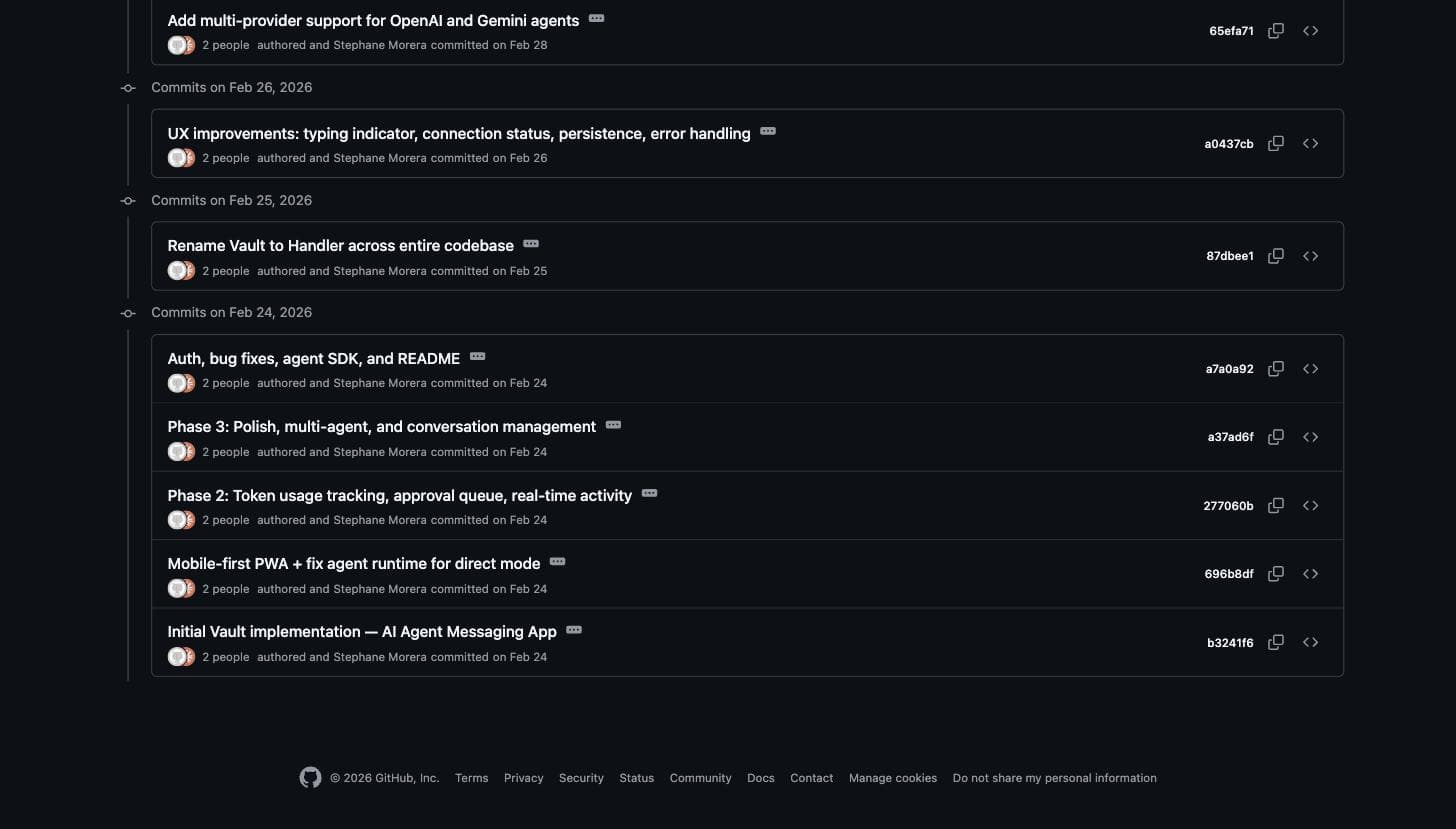
I’m not claiming Block copied a repo with two stars. Convergent evolution is the point. When a solo founder in DeLand, Florida and a public company led by Jack Dorsey independently build the same product months apart, that tells you where work software is going. Agents are becoming coworkers, and coworkers need a shared room.
Buzz vs. Handler: honest side-by-side
| Dimension | Handler (mine) | Buzz (Block) |
|---|---|---|
| First public release | February 24, 2026 | July 21, 2026 |
| GitHub stars (July 31, 2026) | 2 | 18,971 |
| License | MIT | Apache 2.0 |
| Core idea | Dedicated chat app for AI agents | Shared workspace for humans and agents |
| Collaboration model | One human, many agents | Teams of humans plus teams of agents |
| Agent identity | App-level accounts | Cryptographic keypairs (Nostr), portable |
| Models supported | Claude, GPT, Gemini, custom | Any, via agent harnesses (Claude Code, Codex, goose) |
| Git and workflows | No | Yes (early git integration, YAML workflows) |
| Hosting | Self-host (Node) | Self-host (Docker) or Block-hosted |
| Mobile | PWA | Native apps in development |
| Team behind it | One founder, nights | Block, Inc. |
| Status | Side project, parked | Developer preview, actively developed |
The table is the honest story.
What Block got right that I didn’t
Identity is the real product. I gave agents app-level accounts. Block gave them cryptographic identities that survive outside the platform. On Nostr, an agent’s name, history, and reputation travel with it to any compatible system. That’s the difference between a feature and infrastructure, and it’s the piece I under-built.
The second thing they got right: multiplayer. Handler was one human commanding many agents. Buzz is teams of humans working alongside teams of agents, which is where actual businesses live. And the third is distribution, which nobody outbuilds. Ten days after launch, Buzz is closing in on 19,000 GitHub stars. Handler has 2. The product gap between us was real but closable. The reach gap wasn’t. If you’re a builder, that lesson is worth more than the code: the idea was never the moat.
What this means for your business
Every major push in software right now points the same direction: AI agents are moving from tools you prompt to teammates you work alongside. Buzz makes that concrete and free. Small businesses that learn to run AI teammates now will compound that advantage for years.
Here’s what I’d actually do with it today. If you’re technical or have help, stand up a Buzz community and connect one agent to a real workflow. Within a morning of testing, I had an agent in my workspace answering questions about my company with full context, running on the same setup that powers my client work. That’s AI automation for small businesses in its next form: the agent stops living in a browser tab and starts sitting in your team room.
And if you want your business to be the one AI engines recommend when buyers ask, that’s a different discipline: answer engine optimization, and it’s exactly how a two-star repo founder ends up cited next to a Block launch.
Setting it up: the friction I hit
I set it up both ways this week: self-hosted relay via Docker, and Block’s hosted community. Real friction, so you don’t have to hit it: the “I own the community” button in onboarding routes to Block’s hosted sign-in, so if you’re self-hosting, choose “I’m a member or admin” and enter your relay URL instead. Small stuff, preview-stage stuff. The core loop, @mention an agent and get real work back, already feels inevitable.
FAQ
Is Buzz free?
Yes. Buzz is free and open source under the Apache 2.0 license. You can run your own instance on your own infrastructure at no cost, or sign up for Block's hosted communities. The code is public at github.com/block/buzz.
Does Buzz work with Claude or ChatGPT?
Yes. Buzz is model-agnostic by design. Agents connect through harnesses like Claude Code and OpenAI's Codex, so one workspace hosts agents from different providers side by side. ChatGPT itself isn't the integration; OpenAI models arrive through Codex. I ran my first Buzz agent on Claude Code within an hour of setup.
Should you try Buzz today?
Buzz is worth trying now if you're comfortable with early software. It's a developer preview: the desktop app is solid, but mobile apps aren't out yet and some flows are rough. Non-technical teams should wait a quarter. The hosted version removes most of the setup pain.
What is Buzz built on?
Buzz is built on the Nostr protocol. Every participant, human or agent, holds their own cryptographic keypair, and every message, reaction, workflow step, review approval, and git event is a signed event in one log. That identity is portable and verifiable rather than locked to a vendor account.
The short version of this story, including why I built Handler in the first place, is on LinkedIn.
Stephane Morera is the founder of EVOIX, an AI consulting company in DeLand, Florida that builds automation, AI agents, and answer engine optimization for small businesses. He released Handler, an open-source AI agent messaging app, in February 2026. For the wider picture of how engines decide which business to name, see our guide to AI visibility.